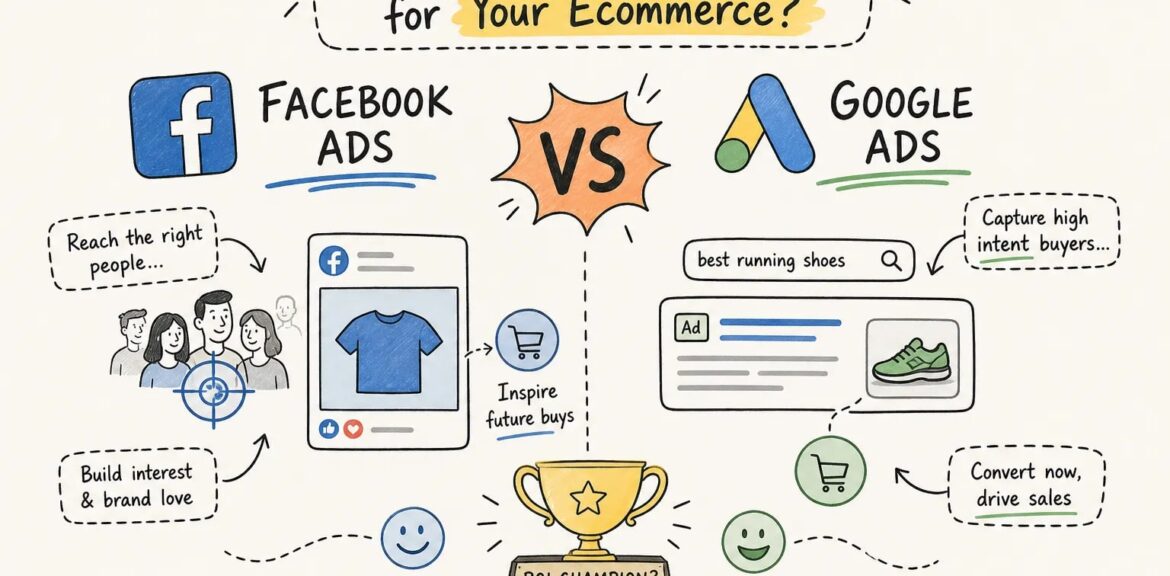

When it comes to Facebook Ads vs Google Ads for ecommerce , most brands pick a side and commit too hard. They either pour budget into Meta because the CPC looks cheap, or default to Google because “intent is higher,” then wonder why neither is delivering the ROAS they expected. The real problem is treating this as an either/or decision when the two platforms serve fundamentally different jobs in the customer journey.
This article breaks down the comparison using real 2026 benchmark data, shows you where each platform wins and why, and gives you a practical framework for deciding where to start, how to split your budget, and when to scale. After years of running both channels for ecommerce clients at EcomTalkPoint, one of the most common budget mistakes we see is over-indexing on one platform at the direct expense of the other.
Watch the clear difference between Facebook Ads and Google Ads
Where Each Channel Fits in Your Ecommerce Funnel
Google Search and Shopping are pull channels. When someone types “waterproof hiking boots size 10” into Google, that person has defined intent, and your ad intercepts an active buying decision already in motion. This is why Google Search typically converts at 1.5, 3.5% for non-brand traffic. You’re not convincing anyone to want the product; you’re showing up at the right moment.
Facebook and Instagram are push channels. Your ad interrupts someone scrolling their feed, so the conversion path is longer and colder. Meta prospecting converts at 0.5, 2.0% because the user wasn’t searching for your product. The platform’s strength is reach, visual storytelling, and audience discovery. It plants the seed that eventually leads someone to search your brand on Google or type your URL directly.
Meta retargeting flips the script entirely. Once someone has visited your site, viewed a product, or abandoned a cart, a Meta retargeting campaign can convert at 2, 5% or higher because the audience is already warm. The critical distinction: don’t benchmark your retargeting ROAS against your prospecting ROAS. They’re different jobs targeting different people at different funnel stages.
Facebook Ads vs Google Ads Ecommerce: ROAS Benchmarks for 2026
Google Search, Shopping, and Performance Max
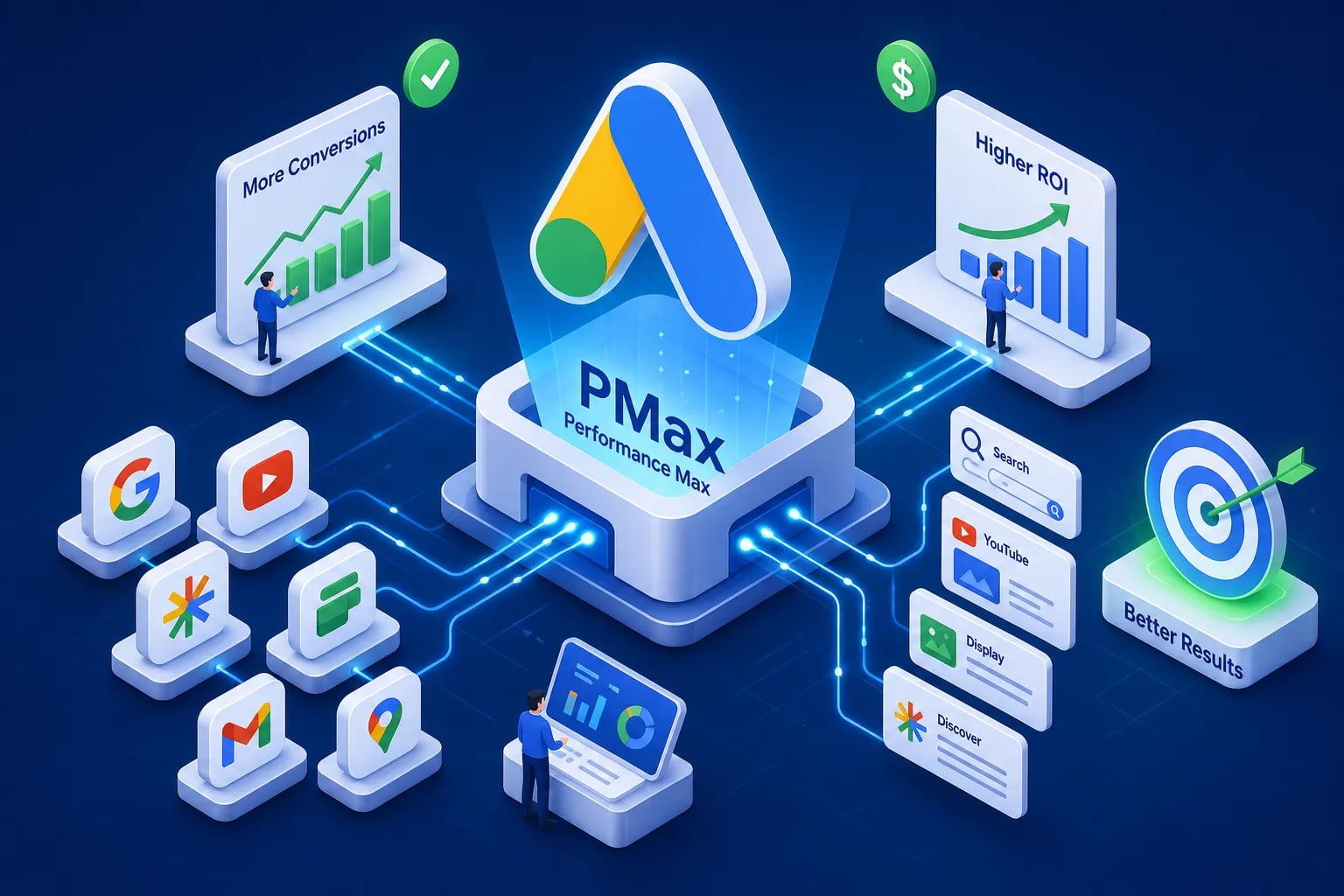
Based on 2026 ecommerce data, Google Search delivers an average ROAS of 4.5, 6.0x, with CPAs ranging from $22 to $51 depending on category and whether branded traffic is included. Google Shopping sits at 2.8, 4.0x ROAS with CPCs around $0.66, $1.32. Performance Max lands in the 2.6, 4.4x range. Shopping CPC by category skews lower for fashion ($0.42) and higher for health and beauty ($0.78). These numbers look strong, but a significant portion of that ROAS is often driven by brand searches capturing buyers who were already on the way to convert.
Meta Prospecting and Retargeting
Meta’s median ecommerce ROAS sits around 1.9, 3.0x for prospecting, with CPCs between $0.67 and $0.78. Retargeting campaigns on Meta regularly outperform that, but the audience size is capped by your existing traffic volume. Health and beauty advertisers on Meta typically see $0.75, $1.00 CPC, while fashion brands often land closer to $0.60, $0.75. These figures are planning benchmarks, not guarantees, and they shift based on creative quality, offer strength, and audience size.
The Attribution Problem Neither Platform Tells You About
Here’s where most ecommerce advertisers go wrong. Google and Meta both use their own attribution windows, and both can claim the same sale. A shopper sees a Meta prospecting ad, then searches the brand name on Google, clicks a paid search ad, and buys. Meta claims the sale based on its 7-day click window. Google claims it based on the last paid click. Your dashboard shows $200 in revenue attributed across both channels while you actually made one $100 sale. Incremental ROAS, not platform ROAS, is the number that actually tells you whether a channel is working.
Targeting Depth and Creative Demands on Each Platform
Google targets based on what people are actively searching, which means keyword match types, search intent, and feed quality determine who sees your ads. A well-structured Google Shopping feed with accurate titles, prices, and attributes does more for targeting accuracy than any audience layer. Meta operates on behavioral signals: interests, demographics, lookalike audiences, and purchase history. Broad targeting with Meta’s machine learning often outperforms heavily layered audiences, especially after iOS privacy changes reduced signal fidelity for US advertisers.
On Google Search, your ad is text. Relevance and offer clarity in your headline and description determine click-through rate. On Google Shopping, your product image and price are the creative. On Meta, creative is the targeting. The image or video you run determines who stops scrolling, and weak creative is the single biggest driver of poor Meta ROAS. UGC-style video, short-form Reels under 15 seconds, and authentic product demos consistently outperform polished brand content on Meta prospecting. Each platform demands a completely different production approach and testing cadence.
Creative efficiency only tells part of the story, though, because how you measure results across both platforms shapes every budget decision you make. Because Google and Meta each operate within their own attribution ecosystems, adding up their reported revenues creates a double-counting problem. Using a blended metric like Marketing Efficiency Ratio (total revenue divided by total ad spend) alongside geo holdout tests gives you a cleaner picture of what each channel actually contributes. Treat Google brand search and Meta retargeting ROAS numbers with particular skepticism, as both channels disproportionately capture users who were already close to converting.
How to Split Your Budget and Run a Structured 90-Day Test
A practical starting split for most ecommerce brands is 60% Meta and 40% Google. If your product is novel, visual, or has low existing search volume, shift toward 70% Meta and 30% Google. If your product solves a clearly searched problem, flip closer to 40% Meta and 60% Google. Within Google, always separate brand search, non-brand search, Shopping, and Performance Max so cheap branded conversions don’t make the whole channel look better than it is. Within Meta, separate prospecting from retargeting budgets from day one.
The first 30 days are about data collection, not optimization. Run both platforms with stable budgets, consistent creative, and identical landing pages. Don’t judge either channel on day 10. From days 31, 60, compare incremental orders and contribution margin at the store backend, not in platform dashboards. Move budget in 10, 20% increments toward the channel producing stronger marginal returns. In days 61, 90, run a simple geo holdout test: reduce spend on one platform in a matched geographic segment and measure the impact on total orders, not attributed orders. This tells you what’s actually incremental.
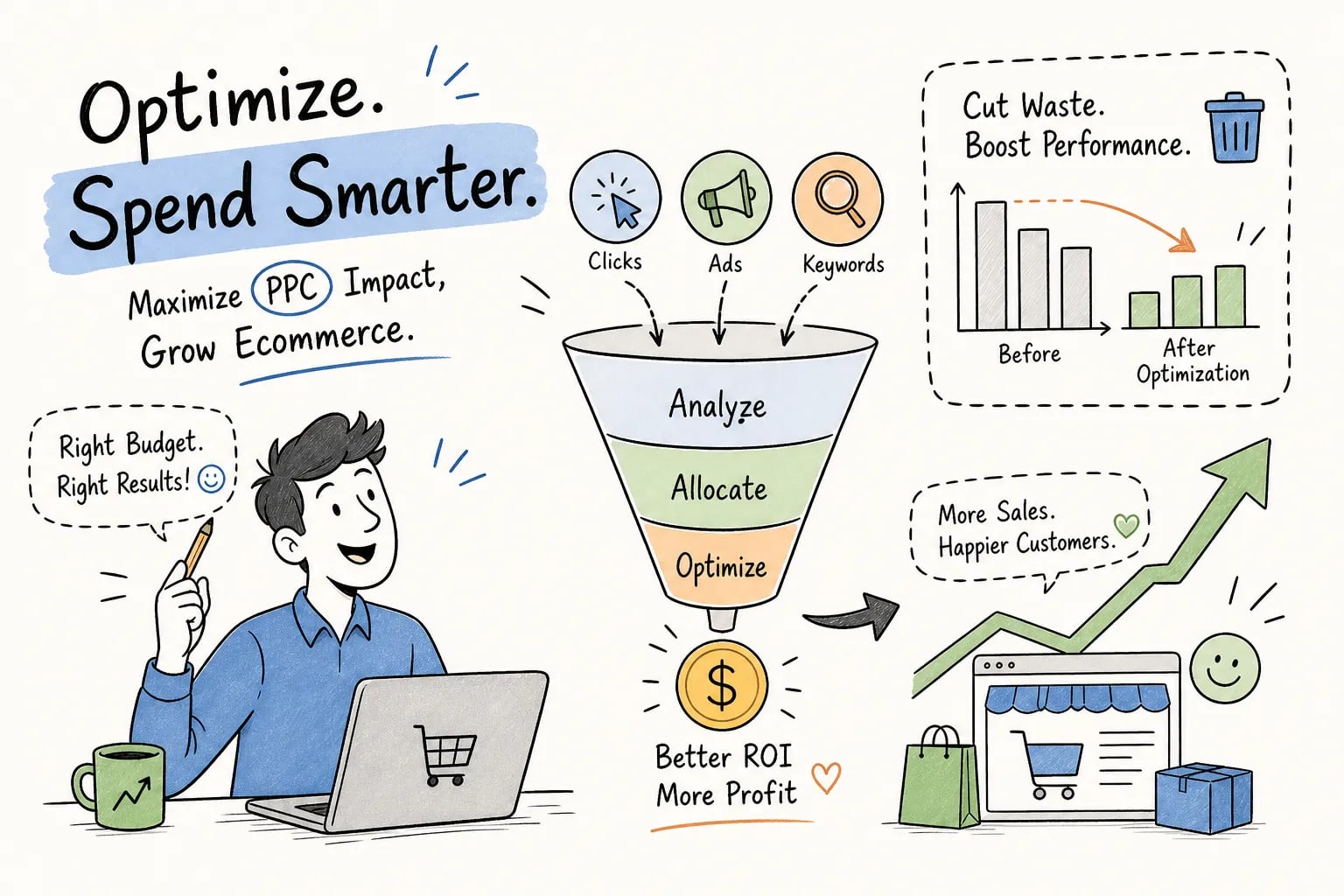
The core metrics to track throughout are blended MER, new-customer CAC, contribution profit after ad spend, and total order volume. Don’t scale a channel because its platform ROAS looks high. Scale it because total store profit improved when you put more money into it. Review weekly, but make major allocation decisions no more than once every two weeks to avoid reacting to noise rather than signal.
Which Platform Fits Your Product, and the Case for Running Both
Google is the stronger lead channel when your product has strong category search volume, when purchase decisions are researched rather than impulse-driven, and when your AOV is high enough to support competitive CPCs. High-consideration products like furniture, specialty outdoor gear, or B2C software with clear problem-solution search terms belong in Google Shopping and Search first. Performance Max can supplement reach once Shopping and Search campaigns are optimized and generating reliable conversion data.
Meta earns the lead when your product is visually compelling, when the category doesn’t have strong organic search demand, or when your growth depends on building brand awareness and top-of-funnel volume. Fashion, beauty, food and beverage, and lifestyle products tend to perform well when Meta prospecting introduces the product to cold audiences and retargeting closes the loop. Meta is also where you test creative angles, refine your audience definition, and generate the kind of traffic that later converts via Google branded search.
Brands that run coordinated multi-channel strategies consistently outperform single-channel bets. Archie Rose, for example, combined Google PPC with Facebook and Instagram and reported more than 230% growth in digital marketing revenue. The trap isn’t choosing the wrong platform; it’s running both in silos where Meta and Google optimize against each other’s attributed conversions instead of against shared business goals.
This is exactly the kind of strategy problem EcomTalkPoint solves for ecommerce brands. We build both channels to work together using shared attribution logic, aligned creative strategy, and budget allocation based on incremental contribution rather than platform-reported ROAS. If you’re running both channels and they still feel disconnected, that’s a strategy problem, not a platform problem.
The Decision That Actually Moves Revenue
Framing Facebook Ads vs Google Ads for ecommerce as a binary choice is the wrong starting point. Google captures the demand your brand builds. Meta builds the demand Google later captures. The brands generating the strongest ROAS in 2026 aren’t picking sides; they’re running coordinated campaigns that respect what each platform does best, measure true incremental return, and shift budget based on contribution margin rather than dashboard numbers.
Start with the 60/40 split, keep your attribution clean, separate brand traffic from acquisition traffic, and give each platform 30 days of stable data before making allocation decisions. The 90-day framework outlined above gives you a structured path from launch to confident budget decisions. When comparing Facebook Ads vs Google Ads for ecommerce , the goal is measuring incremental contribution rather than platform-reported ROAS, that single shift in measurement changes every allocation decision you make. If you want both channels managed inside a single, profit-first strategy, reach out to the EcomTalkPoint team. We work with ecommerce brands to build exactly that setup, without the wasted spend that comes from running blind on either side.